


This week, I am going to try to answer 2 questions-
Do you have any advice on soldering large, flat pieces of metal onto other sheet metal? Right now I'm working on a thin, pierced sheet that I'm soldering down to a heavy 18ga backing, for a pendant. But the thin sheet is no longer perfectly flat since it deformed a tiny bit while I was sawing, oh no! My current plan is to try re-flattening the thin sheet between two steel blocks, then sweat solder it down, using some small paper clips or similar items to press the two sheets together while soldering. Do you think it'll work?
Thanks!
-Riv from Purpleshiny
AND-
The price of silver and non-traditional metals: Options and ways of
keeping your skin from going green with alternative metals.
Kelly
Let's start with Riv's question first. We've all sawed something and had some part of it bend! UGH. There are a couple things you can do to try to get that kink out and to have it lay flat again. One of the best things you can do is to flatten the piece between 2 steel blocks, as you described. Place the piece between 2 flat steel pieces and hit it hard with a hammer. Make sure you've annealed the piece first. If that doesn't work, I've flattened a kink by GENTLY rolling it through a rolling mill- set at almost the metal's thickness. You don't want to thin the metal or curl it but this won't happen if it just barely touches the metal as it goes through the rollers. I find this almost always works. Of course, some pieces are too large to fit through a rolling mill.
Another trick is to put the piece on your bench top with the kink overhanging the edge, just out into space. Gently push the piece down with your fingers or a wooden dowel (this will not leave marks). Remember there is nothing supporting the piece you are pushing down- it is hanging out in air, so easy does it! You don't want to push it too far the other direction.
Finally, you can anneal it and try to hit it with a rawhide on a steel block from both sides but this doesn't work as well as the other ideas, in my opinion.
Sometimes, in spite of your best efforts, there is a shadow of a kink left. If the piece is thick enough, go ahead and use it and file and sand the area flat later.
Now, let's talk about soldering those sheets together- your paper clip idea is not going to be effective. Paper clips are too light to really hold anything down. First of all, pre-melt solder all over the back of the top sheet to prepare for sweat soldering. Lay the pre-soldered piece onto the fluxed bottom sheet. If there is a big discrepancy between the sheet gauges- say the top sheet is 26 g and the bottom sheet is 18 g- then you definitely want to put the piece on a tripod or solder support and solder from below. The heat must go onto the heavy gauge sheet primarily for that to work. If the sheets are close to the same thickness, I put it on a brick and solder from above, still heating around the brick a lot, to focus heat on the bottom sheet.
As far as supports for the top piece- you want to use something that will weigh the piece down to keep it flat and to keep it from shifting. The problem is, you don't need a heat sink. I have a great trick to share with you! Make a solder-bot.....what?
You can make your own if you know how to weld steel or have someone make one for you, like in this picture with Tom Muir's version. He made his own here.

You can also purchase something similar from Chris Hentz- I bought 3 of these and they work by a similar mechanism. The beauty of these solder helpers is that they provide the weight to hold a piece down firmly, but because they come to a tiny point, they do not act as a heat sink. Also, they can be configured to hold just about anything. Brilliant!


Now for Kelly's question- yes, brass and copper and alternative metals have become very popular lately due to the high cost of silver. You can seal your metals with wax and sealers (I believe we covered this in a previous post), but why not line your copper and brass in silver? You save money because you can use a very thin sheet of silver- 28 gauge is fine. This also solves the problem of having the customers' skin turn green because it will be the silver that is touching it. It also gives a very nice, finished look to your piece. You will use the above sweat soldering technique to do this. Here is a piece by my friend CG Whitfield that he made doing exactly that.

Hope that helps all of you become better solderers. Til next week, happy metalsmithing,
Sue
AND-
The price of silver and non-traditional metals: Options and ways of
keeping your skin from going green with alternative metals.
Kelly
Let's start with Riv's question first. We've all sawed something and had some part of it bend! UGH. There are a couple things you can do to try to get that kink out and to have it lay flat again. One of the best things you can do is to flatten the piece between 2 steel blocks, as you described. Place the piece between 2 flat steel pieces and hit it hard with a hammer. Make sure you've annealed the piece first. If that doesn't work, I've flattened a kink by GENTLY rolling it through a rolling mill- set at almost the metal's thickness. You don't want to thin the metal or curl it but this won't happen if it just barely touches the metal as it goes through the rollers. I find this almost always works. Of course, some pieces are too large to fit through a rolling mill.
Another trick is to put the piece on your bench top with the kink overhanging the edge, just out into space. Gently push the piece down with your fingers or a wooden dowel (this will not leave marks). Remember there is nothing supporting the piece you are pushing down- it is hanging out in air, so easy does it! You don't want to push it too far the other direction.
Finally, you can anneal it and try to hit it with a rawhide on a steel block from both sides but this doesn't work as well as the other ideas, in my opinion.
Sometimes, in spite of your best efforts, there is a shadow of a kink left. If the piece is thick enough, go ahead and use it and file and sand the area flat later.
Now, let's talk about soldering those sheets together- your paper clip idea is not going to be effective. Paper clips are too light to really hold anything down. First of all, pre-melt solder all over the back of the top sheet to prepare for sweat soldering. Lay the pre-soldered piece onto the fluxed bottom sheet. If there is a big discrepancy between the sheet gauges- say the top sheet is 26 g and the bottom sheet is 18 g- then you definitely want to put the piece on a tripod or solder support and solder from below. The heat must go onto the heavy gauge sheet primarily for that to work. If the sheets are close to the same thickness, I put it on a brick and solder from above, still heating around the brick a lot, to focus heat on the bottom sheet.
As far as supports for the top piece- you want to use something that will weigh the piece down to keep it flat and to keep it from shifting. The problem is, you don't need a heat sink. I have a great trick to share with you! Make a solder-bot.....what?
You can make your own if you know how to weld steel or have someone make one for you, like in this picture with Tom Muir's version. He made his own here.
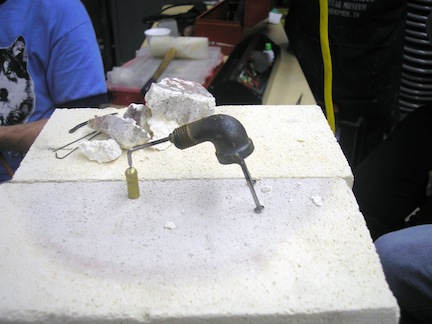
You can also purchase something similar from Chris Hentz- I bought 3 of these and they work by a similar mechanism. The beauty of these solder helpers is that they provide the weight to hold a piece down firmly, but because they come to a tiny point, they do not act as a heat sink. Also, they can be configured to hold just about anything. Brilliant!


Now for Kelly's question- yes, brass and copper and alternative metals have become very popular lately due to the high cost of silver. You can seal your metals with wax and sealers (I believe we covered this in a previous post), but why not line your copper and brass in silver? You save money because you can use a very thin sheet of silver- 28 gauge is fine. This also solves the problem of having the customers' skin turn green because it will be the silver that is touching it. It also gives a very nice, finished look to your piece. You will use the above sweat soldering technique to do this. Here is a piece by my friend CG Whitfield that he made doing exactly that.

Hope that helps all of you become better solderers. Til next week, happy metalsmithing,
Sue


